A note for poultry and cut flower farmers on what your organic waste is really worth — and what it’s costing you to ignore it.
Every flock cleanout leaves you with the same problem: a barn full of litter — manure, bedding, feathers — that needs to go somewhere. Every harvest cycle leaves cut flower growers with stems, rejected blooms, and green waste that piles up faster than it can be removed.
For most operations, “somewhere” means hauling it off-site, stockpiling it until someone else deals with it, or spreading it raw and hoping for the best.
None of those options are getting easier. And one of them is about to get a lot more expensive.
The Regulatory Pressure Is Real and It’s Moving Fast
Ontario’s packaging and organic waste regulations have been tightening steadily, and 2026 marks a significant shift. Under the province’s expanded Extended Producer Responsibility framework, businesses face increasing accountability for how organic waste is managed — not just what gets recycled. For farms generating consistent volumes of organic material, the question of how that waste is handled is moving from a management inconvenience to a compliance issue.
South of the border, it’s already a legal matter in several states. California’s SB 1383 mandates 75% diversion of organic waste from landfill. Washington State’s HB 1799 requires commercial food waste generators to separate and divert organic material. New York’s Food Waste Reduction Act is expanding its reach. These frameworks don’t stop at restaurant kitchens — they apply to agricultural operations generating organic waste above threshold volumes.
If your operation ships product into any of these markets, or if your provincial government is watching how neighbouring jurisdictions enforce, the direction of travel is clear.
What Poultry Litter Is Actually Worth
Poultry litter — the combination of manure, bedding, and organic material from a flock — is one of the most nutrient-dense organic materials that exists. It’s high in nitrogen, phosphorus, and potassium. When composted properly, it becomes a stable, predictable soil amendment with measurable agronomic value.
The problem is “when composted properly.” Raw litter applied directly to land carries pathogen risk — E. coli, Salmonella, and other organisms that require time and temperature to neutralize. It also carries ammonia volatilization risk, meaning the nitrogen you want in your soil escapes into the air before it does any work. And it can cause nutrient runoff issues that attract regulatory attention.
Composted litter is a different product entirely. The composting process — sustained temperatures above 55°C for a minimum period — neutralizes pathogens, stabilizes nitrogen so it’s available to plants rather than lost to the atmosphere, and reduces litter volume significantly. What you’re left with is a product you can apply to your own land, sell to neighbouring operations, or use to reduce synthetic fertilizer inputs.
For a commercial poultry operation doing regular barn cleanouts, the volume of material going through a properly managed on-site composter can represent thousands of dollars in fertilizer value annually — value that currently either walks out the gate on a hauler’s truck or gets spread raw and underperforms.
What Cut Flower Growers Are Throwing Away
The economics for cut flower operations are different but the principle is the same.
A working cut flower farm generates substantial green waste: rejected stems, spent blooms, end-of-season plant material, and crop residues. This material is high in organic matter and, when composted, produces exactly the kind of biologically active soil amendment that intensive flower production requires.
Flower growers are often already spending significantly on compost inputs — bagged or bulk amendments to maintain soil structure and fertility through repeated cropping cycles. On-site composting closes that loop. The waste your operation generates in one part of the cycle becomes the input it needs in the next.
There’s also a practical benefit that matters at scale: reducing haul-away costs. Green waste removal for a mid-sized cut flower operation can run hundreds to thousands of dollars per season depending on volume and location. Processing it on-site converts that cost into an asset.
Why “I’ll Just Windrow It” Isn’t Enough
Windrow composting — building long piles and turning them with equipment — works at large scale but creates problems at farm scale. It requires space, equipment, and management time. Open windrows can create odour issues that attract complaints from neighbours or scrutiny from environmental officers. And without temperature monitoring and proper turning, pathogen kill isn’t guaranteed, which matters if you’re applying the compost to land where food or flowers are grown.
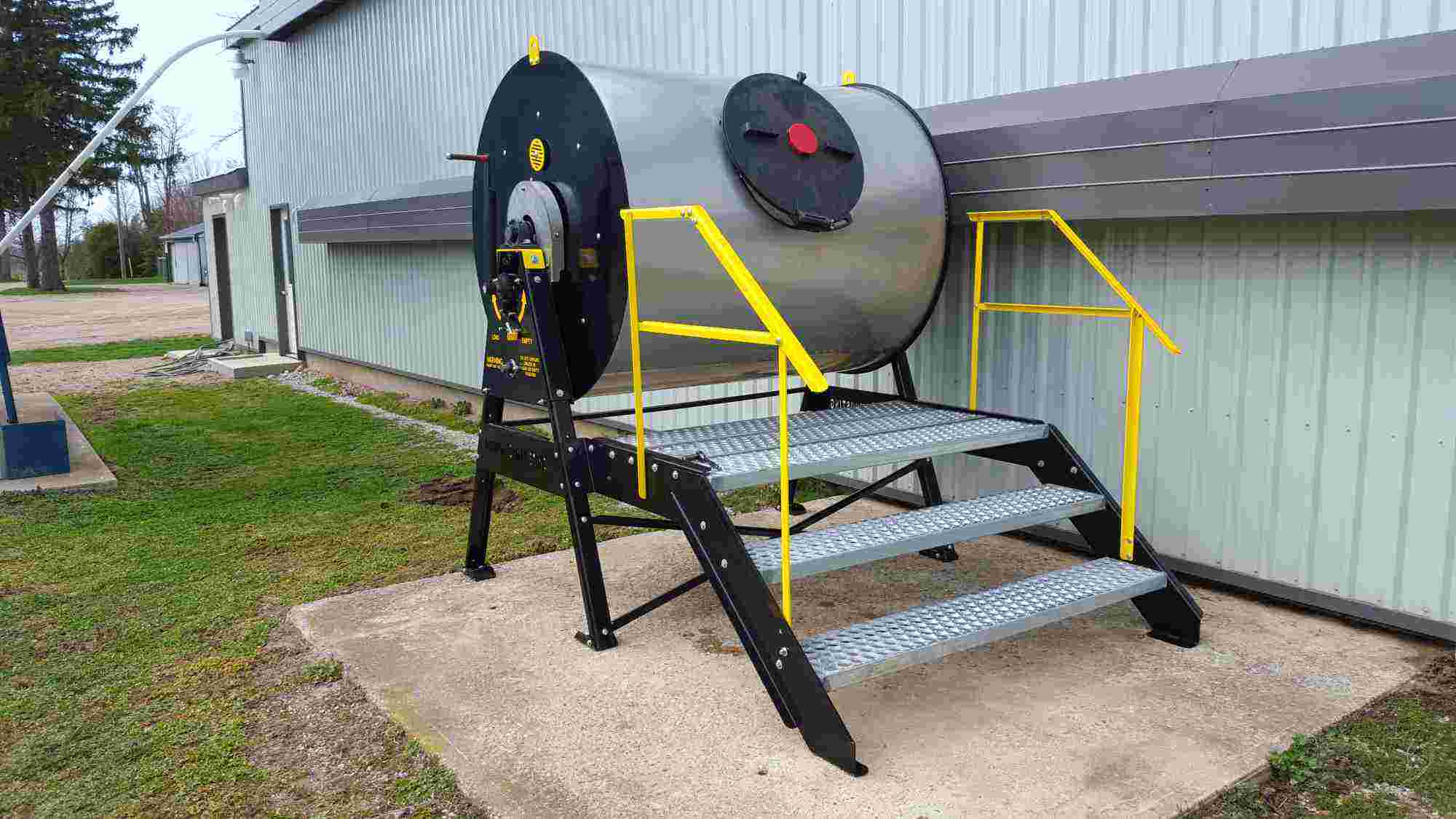
Batch composting in an enclosed unit solves the problems windrow systems create. The process is contained, temperature is managed by the batch environment rather than by the weather, and the footprint is small enough to fit in an existing outbuilding or alongside a barn. No electricity required. No specialized training.
For an operation that’s doing a barn cleanout every six to eight weeks, or harvesting green waste continuously through a growing season, a batch composter processes material in manageable cycles and produces a finished product on a predictable timeline.
The Compliance Angle You Shouldn’t Wait On
Here’s what’s worth understanding about agricultural organic waste regulation: it tends to follow the same trajectory as food service regulation did a decade ago. First comes voluntary guidance. Then comes municipal or regional requirements. Then comes provincial or state-level enforcement.
Restaurants in Ontario and California didn’t get fined on day one of organic waste regulations — but the operations that set up compliant systems early avoided scrambling when enforcement arrived and avoided the cost of reactive compliance.
For poultry and flower operations, the window to get ahead of this is open now. On-site composting is a defensible, documented approach to organic waste diversion. It creates a paper trail that shows regulators you’re managing waste responsibly. And it does so while generating value rather than incurring cost.
What to Do Next
If you’re generating organic waste at scale — whether that’s poultry litter from a commercial flock or green waste from a cut flower operation — there are two useful things to do right now.
First, check your jurisdiction’s current requirements. Our Compliance Hub covers organic waste regulations across Ontario and major US states, including the thresholds that trigger mandatory diversion requirements and the documentation needed to demonstrate compliance.
Second, find out what on-site composting would actually cost and return for your specific operation. The numbers depend on your waste volume, your current disposal costs, and the fertilizer value of the compost you’d produce. We run those numbers for free.
Get a quote and ROI analysis →
NutrientReturn.com connects Canadian and US agricultural operations with commercial composting equipment sized for farm-scale organic waste. No electricity required. Shipped anywhere.
Ready to close the nutrient loop?
Tell us about your operation and we'll run the numbers — free, no obligation.
Get a Quote