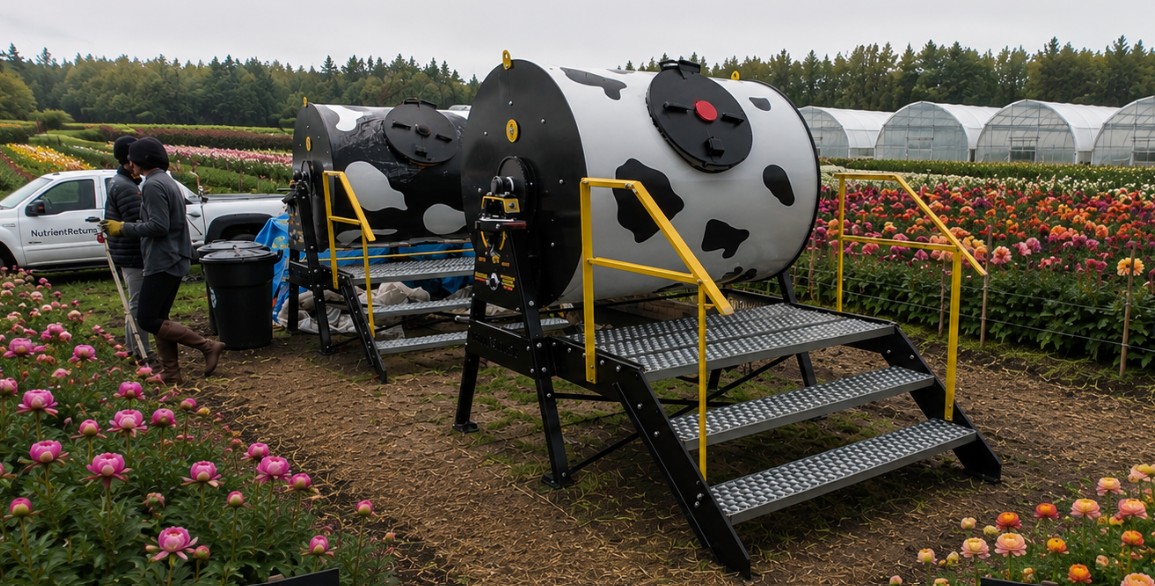
Ask a peony, dahlia, or ranunculus grower what their biggest input cost is, and soil amendment is almost always somewhere near the top of the list. These aren’t row crops grown on volume and thin margins per acre — they’re intensive, high-value beds that get rebuilt and re-amended constantly, sometimes multiple times in a single season.
That means most specialty cut flower operations are buying compost regularly. Delivered bulk compost commonly runs somewhere in the $15–$25 per cubic yard range before delivery, and a 3–4 inch layer worked into a bed before planting — the standard practice among serious growers — adds up fast across even a modest number of beds, repeated every time a bed turns over.
At the same time, the same operation is producing exactly the raw material that compost is made from — and paying to get rid of it.
The waste that’s already sitting there
Every growing season leaves a specialty flower farm with a steady stream of organic material: rejected stems that don’t meet cut-quality standards, spent blooms, foliage trimmed for stem length, and end-of-season plant material pulled at bed turnover. For crops like dahlias and ranunculus, where a meaningful share of what’s grown never makes it to a bucket, that cull volume isn’t a rounding error — it’s a real percentage of total plant mass grown in a season.
Right now, on most farms, that material either gets hauled off, left to break down slowly and unevenly in a corner of the property, or composted the slow way — an open pile that takes months, needs turning, and doesn’t reliably hit the temperatures needed to kill weed seeds and pathogens before it goes back on a production bed.
The reframe: you’re not disposing of waste, you’re skipping a step
The input you’re buying and the output you’re throwing away are the same material, on either end of a process you’re not running. An in-vessel composter closes that loop on-site — turning cull stems, spent blooms, and bed-turnover material into finished, weed-seed-safe compost in weeks rather than months, without the space, smell, or inconsistency of an open pile.
For an operation already spending real money on delivered compost every season, that’s not a sustainability talking point. It’s a direct line item that gets smaller — potentially close to zero for compost inputs — the more of your own cull volume you’re able to process and put back into your own beds.
Why this vertical is different to sell into
Most operations that buy the Batch 45 need to find an internal champion — someone who’ll own the equipment day to day so it doesn’t become an expensive bin nobody uses. Specialty cut flower farms are often the exception. On a lot of these operations, the grower who decides what goes into the soil is the same person who’ll be running the composter. There’s no internal handoff required, no one else to convince. The person who feels the cost of buying compost every season is the same person who’d feel the benefit of not having to.
What it takes
A single Batch 45 unit runs $9,500, needs no power hookup, and processes material in a footprint that fits next to an existing outbuilding or greenhouse. For a farm already running a tight input budget on a small number of intensive beds, the math isn’t abstract — it’s the difference between paying for compost every season and producing it.
Ready to close the nutrient loop?
Tell us about your operation and we'll run the numbers — free, no obligation.
Get a Quote