For educators who want their students to understand where food comes from — and where it goes.
Every September, science teachers across Ontario and North America look for ways to make environmental concepts tangible. Climate change. Waste reduction. Sustainable agriculture. The concepts are important. But the lessons that stick are the ones students can touch, smell, and watch change over time.
A commercial batch composter might be the most honest teaching tool you’ve never considered.
What Composting Teaches That a Textbook Can’t
Composting is biology, chemistry, and systems thinking happening in real time — right in front of your students.
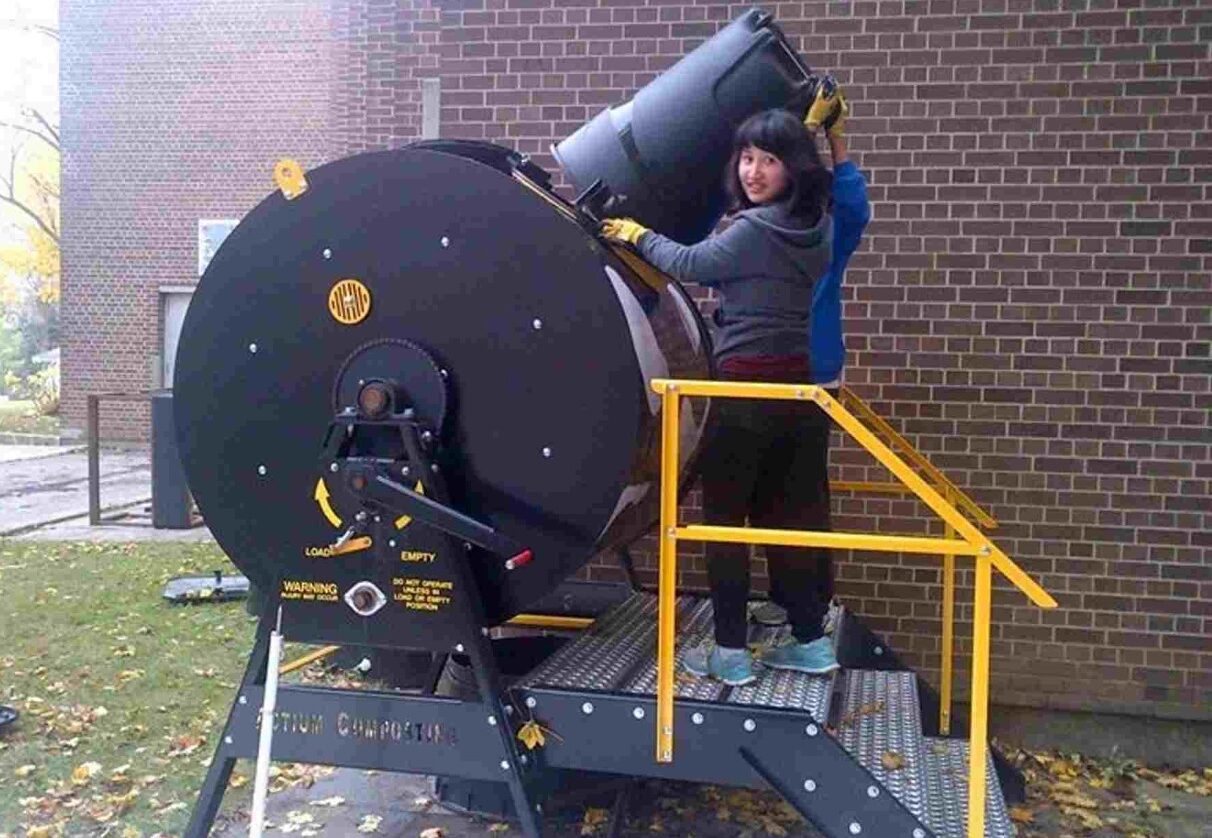
When a class loads organic waste into a composter and cranks it for the first time, they’re not reading about decomposition. They’re managing it. They’re making decisions. They’re watching what happens when the carbon-to-nitrogen ratio is off, when moisture is too high, when the drum heats up and why that matters.
The Essential Batch 45 commercial composter runs entirely on manual power — no electricity required. That means students are physically involved in every turn. They feel the heat radiating from the drum. They track the temperature. They adjust. They observe.
That’s not a worksheet. That’s science.
The Carbon-to-Nitrogen Ratio: A Lesson That Runs All Semester
One of the most powerful things about running a composter in an educational setting is that it teaches students about balance — specifically the carbon-to-nitrogen ratio that drives decomposition.
Too much nitrogen (food scraps, grass clippings) and the contents go anaerobic and smell. Too much carbon (cardboard, dry leaves) and decomposition slows to a crawl. Get it right — roughly 25–30 parts carbon to 1 part nitrogen — and the drum heats up, microbes flourish, and finished compost appears in weeks.
Students learn to read the drum. They adjust the inputs. They document what works and what doesn’t. Over a semester, they develop an intuitive understanding of nutrient cycles that no multiple choice test can measure.
What Goes In. What Comes Out.
Schools generate more organic waste than most people realize. Cafeteria scraps, paper towels, yard waste, food prep from culinary programs — it adds up fast and most of it goes straight to landfill.
A single Essential Batch 45 unit processes up to 500 pounds of organic material per week. Over a typical 28-week school year, that’s 14,000 pounds of organic material diverted from landfill — from a single unit, on school property, operated entirely by students.
That number isn’t theoretical. Rosebank Elementary in Nashville diverted 13,775 pounds of food waste in a single school year through their student-led composting program — preventing 661 pounds of methane from entering the atmosphere and producing 4,500 pounds of finished compost for local farms and community gardens. Their story is documented here.
The finished compost from your school can go to a school garden, a local farm, or a community green space. The nutrient loop closes right on school property.
No Power. No Plumbing. No Complicated Installation.
One of the practical barriers to bringing composting into schools is infrastructure. Most composting systems require electrical hookups, water lines, or specialized ventilation. The Essential Batch 45 needs none of these.
It runs on a manual crank. It can be placed in a courtyard, a loading dock, a greenhouse, or any outdoor space with reasonable access. Setup takes hours, not weeks. And because there are no mechanical components to fail, ongoing maintenance is something students can handle themselves — which is part of the point.
Curriculum Connections Are Already There
This isn’t a detour from the curriculum. It’s a hands-on delivery mechanism for concepts already in it.
For science classes: decomposition, microbiology, chemistry of organic matter, nutrient cycling, ecosystem dynamics.
For environmental studies: waste diversion, circular economy principles, carbon sequestration, soil health.
For math classes: measuring inputs and outputs, calculating diversion rates, tracking temperature over time, analyzing data.
For culinary and agriculture programs: food waste reduction, soil amendment quality, connection between kitchen waste and growing conditions.
One composter. Multiple subject areas. A full semester of observable, documentable learning.
It’s Already Been Done — With Grant Money
Here’s the part that usually surprises educators: schools that have done this haven’t always paid for it themselves.
North Country School in New York received a NYSERDA grant to design and install a drum composting system. Their unit processes all food scraps into nutrient-rich compost in 28 days, with the finished material going directly back to campus garden beds — closing the nutrient loop on school grounds.
Mansfield Middle School in Connecticut launched a grant-funded composting program through the Connecticut Department of Environmental Protection that now diverts approximately 9,000 pounds of food waste per year from incineration. The program became such a model that the school authored a how-to manual adopted by schools across the state.
In many Canadian and US jurisdictions, composting equipment for schools can be funded through federal green infrastructure grants, provincial sustainability programs, foundation grants, and school board environmental funds. We’ve built a grant finder tool at NutrientReturn.com that maps available funding by province and state — many schools have accessed 50–100% of their program costs through these sources.
If budget is the reason this conversation hasn’t happened at your school yet, it may not be as much of a barrier as you think.
Where to Start
The best composting programs in schools started with one teacher who thought it was worth trying.
If that’s you — if you’re spending this summer planning what September looks like and you want something real for your students to work with — we’d like to talk.
Visit nutrientreturn.com to explore the equipment, use the grant finder, or reach out directly. We work with educators to make sure the program fits the space, the budget, and the curriculum before anything gets ordered.
Your classroom could be closing the nutrient loop this fall.
NutrientReturn supplies commercial composting equipment to schools, farms, restaurants, and institutions across Ontario, North America, and globally. No power required. Containerizable for delivery anywhere.
Ready to close the nutrient loop?
Tell us about your operation and we'll run the numbers — free, no obligation.
Get a Quote