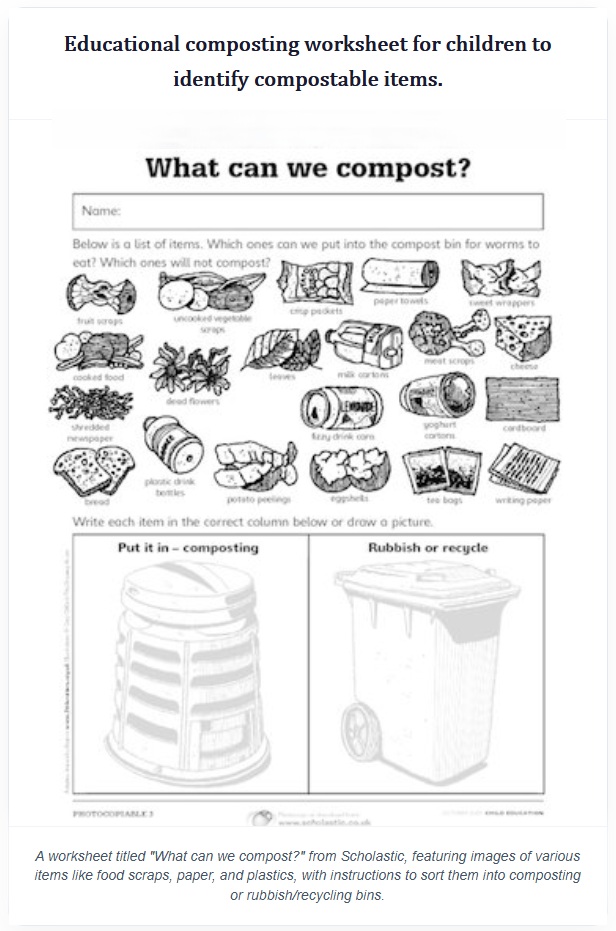
Composting is one of the few environmental concepts kids can actually watch happen. It doesn’t need a diagram of a process they’ll never see — it needs a bin, some scraps, and a few weeks. Back in July we published a single worksheet, “Can It Compost?”, to give teachers a quick way to start that conversation. It turned out one worksheet only covers the first five minutes of the lesson.
So we built the rest of it.
What’s in the series
The Nutrient Loop is a free, five-part worksheet series for grades 3–6 that walks students from “does this go in the bin?” all the way through the science of how nutrients actually cycle back into soil.
- Can It Compost? — Students sort everyday items into compost vs. trash and recycling, with an illustrated item bank and a “did you know” fact on food waste.
- Meet the Decomposers — A matching activity pairing earthworms, fungi, bacteria, and other decomposers with the specific job each one does.
- From Scraps to Soil — Students put the five stages of decomposition in order and chart the heat curve a working compost system moves through.
- Build a Backyard Compost Bin — A hands-on activity sorting “browns” and “greens,” then labeling a bin cross-section with the right layering, moisture, and airflow.
- Composting Myths: True or False? — A ten-question quiz that clears up the most common misconceptions kids (and adults) have about composting.
Each sheet stands alone, so a teacher can pull just one for a single lesson, or work through all five as a short unit.
Why worksheets instead of a lecture
Nutrient recovery is easiest to teach as something students can trace step by step: what goes in, what breaks it down, what comes out the other side. The carbon-to-nitrogen balance that makes a compost system work — the same “browns and greens” ratio we cover on the equipment side of our business — is something a 9-year-old can sort into two piles with their hands before they ever see it written as a ratio. That’s the gap this series is built to close, and it fits naturally alongside science, environmental studies, and math curricula.
Free for classroom use — no equipment required
These worksheets aren’t tied to owning any particular composting system. Any classroom, homeschool group, or nature program can print and use them, whether or not composting is already happening on-site. If your school is further along and thinking about a hands-on, no-electricity composting system that students can actually operate, we covered that in Your Classroom Could Be Closing the Nutrient Loop. Here’s How.
Download the series
The full packet — a cover page plus all five worksheets — is available as one download, or grab individual sheets below.
- Composting Myths Quiz: True or False?
Know a teacher, district sustainability coordinator, or homeschool parent who’d use this? Pass it along.
Ready to close the nutrient loop?
Tell us about your operation and we'll run the numbers — free, no obligation.
Get a Quote